
The Ferrari 360 Modena uses a small, unassuming component that most owners never think about — the oil-to-coolant heat exchanger for the gearbox. Its job is simple: use engine coolant to keep the gearbox oil at a stable temperature. But when it fails internally, the consequences are anything but simple.
What Actually Goes Wrong
Inside the heat exchanger, a bundle of thin metal tubes carries coolant through a chamber filled with gearbox oil (or vice versa, depending on the circuit), with only a thin wall separating the two fluids. Over 15-25+ years, that wall can corrode, pit, or crack. Once it does, coolant and oil are no longer separate — they mix.
The photos below show exactly this failure, caught during a teardown: the coolant side of the exchanger has turned into a thick, green, mayonnaise-like sludge where antifreeze has emulsified with oil, while the untouched half of the core still shows the original brass tubing. The draining fluid coming out of the gearbox is no longer clean gear oil — it’s a dark green, contaminated mixture that has already lost its lubricating properties.
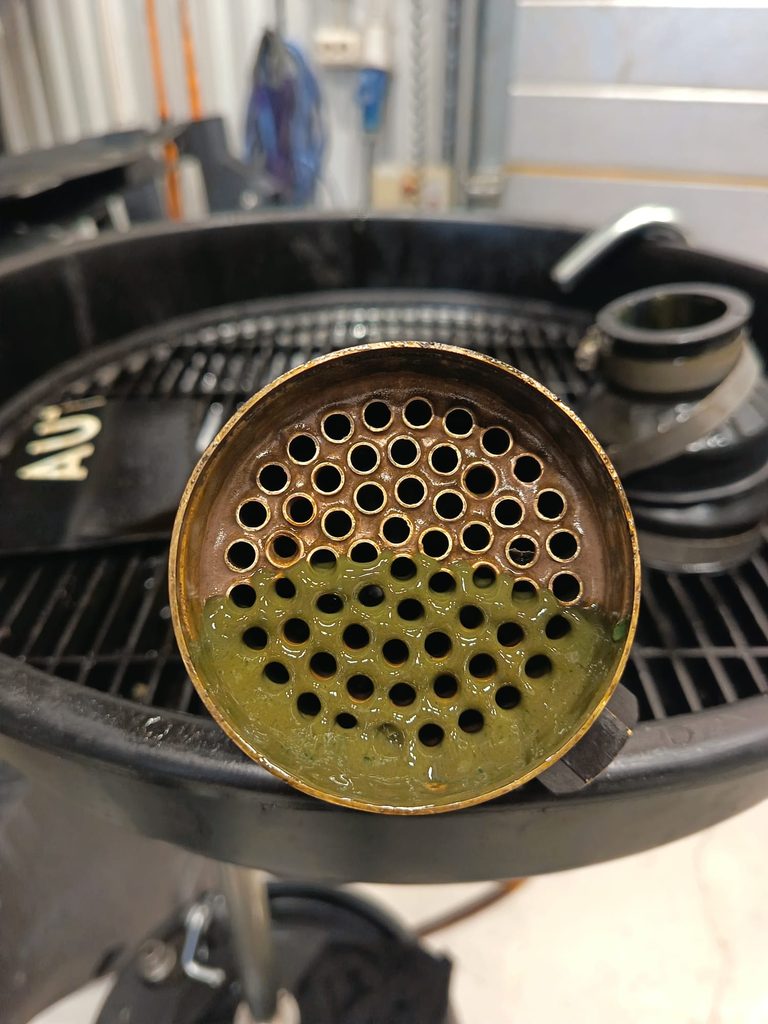
One half of the exchanger core still shows clean brass tubing — the other is coated in emulsified coolant and oil.
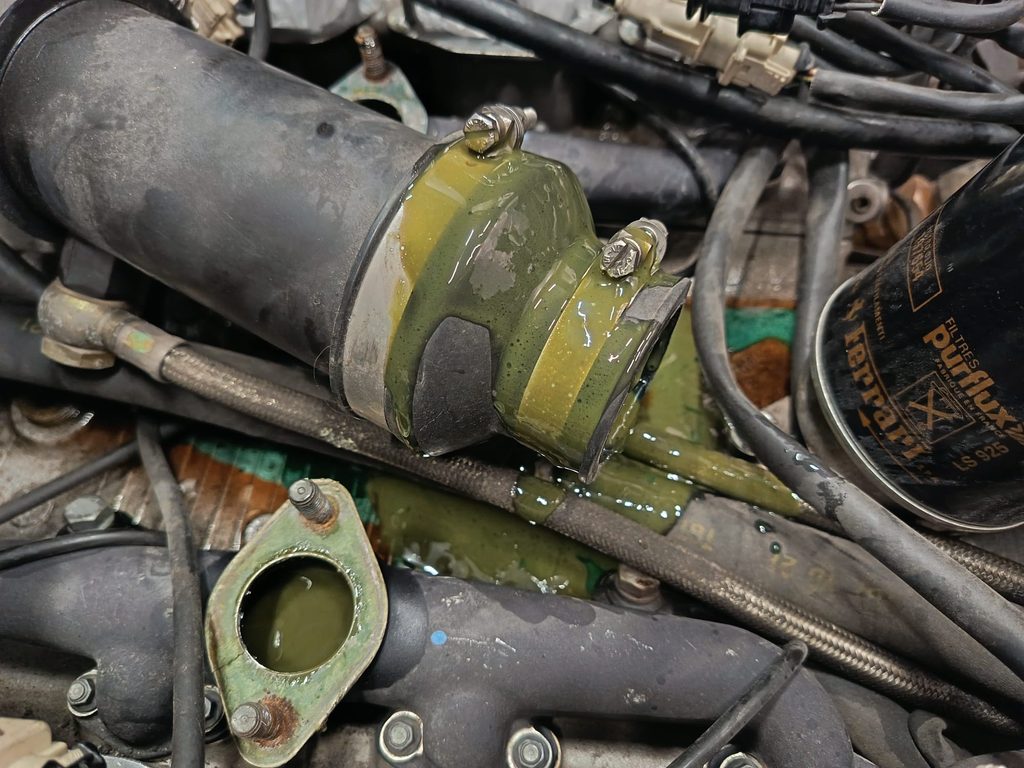
A closer look at the same unit: the green sludge is the result of antifreeze mixing with gearbox oil.
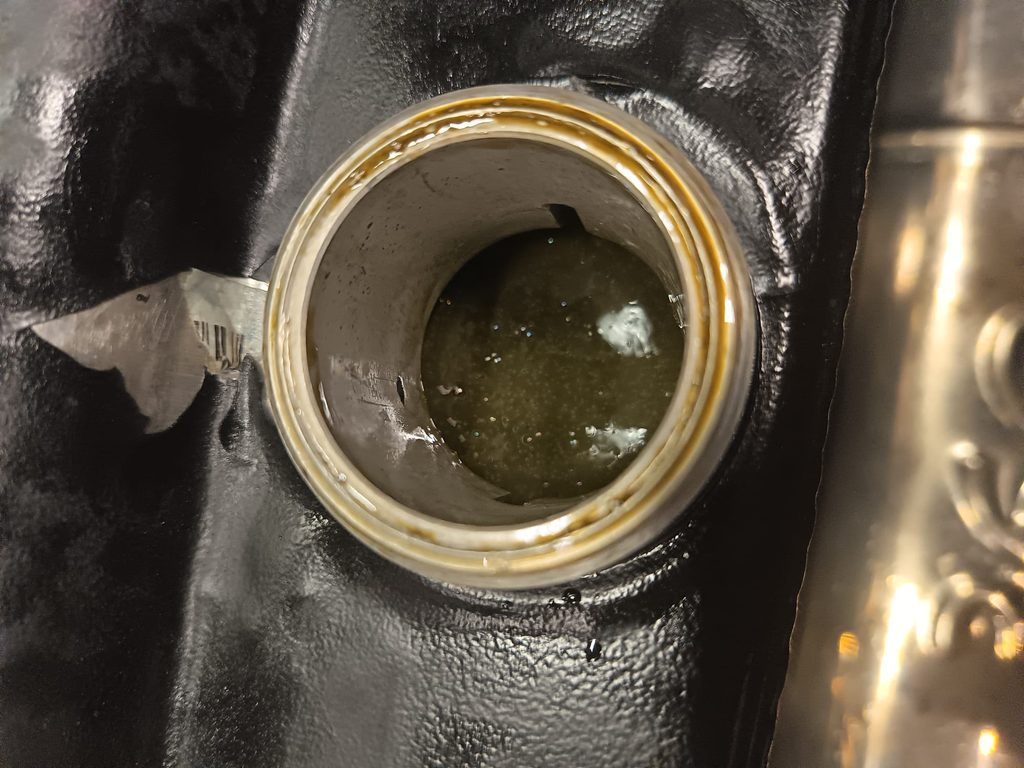
The port itself is filled with the same discolored, emulsified fluid.
Why This Is So Dangerous
Once cross-contamination starts, it rarely stays subtle:
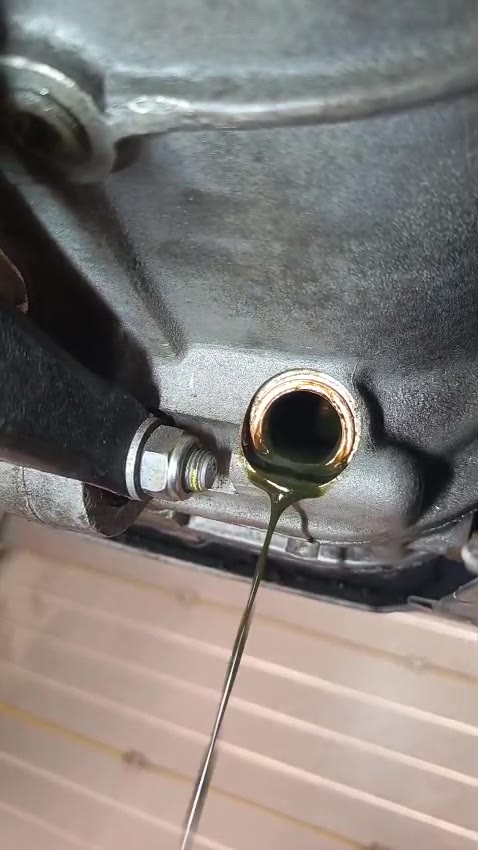
Contaminated fluid draining from the gearbox — no longer clean gear oil, but a dark, coolant-tainted mixture.
- Loss of lubrication: Coolant emulsified into gear oil destroys its ability to protect gears, synchros, and bearings. Wear accelerates rapidly, often silently.
- Coolant loss: As coolant leaks into the oil circuit, the cooling system slowly loses fluid, raising the risk of overheating.
- Cascading damage: A gearbox rebuild on a 360 Modena is a major, labor-intensive job. If the contamination goes unnoticed for too long, what starts as a small, inexpensive part becomes one of the most expensive repairs the car can throw at you.
- Hidden symptoms: There’s often no leak on the garage floor and no unusual noise at first — but the coolant temperature warning light can come on as the system slowly loses coolant into the oil circuit, which is frequently the first real clue something is wrong internally.
By the time the problem is visible — milky or green fluid, a low coolant tank, or gearbox roughness — significant damage may already be underway.
Why Preventive Maintenance Wins
The heat exchanger itself is a relatively inexpensive part compared to the systems it protects. Replacing it proactively, on a mileage or age-based schedule (or during any service where the gearbox oil or coolant is already being touched), costs a fraction of what it takes to:
- Rebuild or replace a contaminated gearbox
- Flush and refill a coolant system repeatedly to chase a slow internal leak
- Diagnose vague drivability issues caused by degraded gear oil
- Deal with secondary damage to seals and bearings inside the gearbox
- An Upgrade That Removes the Risk Entirely
For owners who want to eliminate this failure mode altogether rather than just manage it, there’s an alternative: fitting a dedicated air-to-oil cooler for the gearbox circuit, similar to the setup used on the factory 360 Challenge race cars. Instead of relying on a shared oil-to-coolant exchanger, the gearbox oil is routed through its own radiator, cooled directly by airflow, with no coolant involved anywhere in the circuit.
Since there’s no longer a coolant path running through the gearbox oil system, the entire risk of internal cross-contamination simply disappears — there’s nothing left to corrode and mix the two fluids together. It’s a more involved job than a straight like-for-like replacement, but for a car that’s kept long-term or driven hard, it turns a recurring maintenance item into a non-issue.
The Bottom Line
The oil-to-coolant heat exchanger is one of those parts that owners never notice — until it fails, and by then the bill has grown by an order of magnitude. On a car like the 360 Modena, where the gearbox and cooling system are already expensive to service, a simple visual inspection of fluid color and a proactive replacement of this exchanger at the right interval is one of the cheapest insurance policies you can buy for the car.
If you own a 360 Modena (or any other car with a similar cooler design), check your gearbox oil and coolant color at every service. A greenish tint in the oil, or oil residue in the coolant, is an early warning sign — catching it before it spreads can be the difference between a routine service and a major repair.